
DAY 6
FRIDAY, 21 OCTOBER
We crossed into Uganda. There was a long queue of, mostly, big trucks. Kenya has a seaport so lots of things have to go through Kenya to get to and from markets. Photos were strictly forbidden at the borders, as well as pictures of any police or security checks anywhere on our travels. The vehicle got checked first. Further along, the travellers got processed.
Nothing is as simple as it sounds.
First, we had to show our passport, yellow fever certificate and proof of 2 covid vaccines to an agent. He gave us a scrap piece of paper (there was writing on the back) with our name, our temperature and his signature. We took that piece of paper to another office where they gave it an official stamp. We then took that official stamp to another office, across the street, to get our passports scanned and receive an exit stamp from Kenya. Then we had to go back across the street to get a photocopy of our passport and East Africa visa. The photocopy was one dollar. Then we had to go back across the street to submit the photocopy and get our entry stamp into Uganda. The entire process took us a little over an hour.
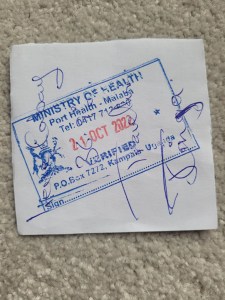
Why did we need the photocopy when our passports were already scanned? Because the immigration people own the copy machine! They get a 100 shilling kickback for every tourist they scam. Patrick pointed out that he and Boniface did not have to do this, nor did other locals – only white tourists. Considering they only make $350 a month and interest rates are 18%, I guess I can’t really blame them. It was only $1 for us. It could make a huge difference in their lives.
Next to the copy machine kiosk was the money exchange booth. While Eli was sorting out the photocopies, Chris decided to exchange their money. Kevin was standing directly behind Eli in the queue. The photocopy man kept talking to Kevin as if Eli were his wife. Kevin and Eli were both trying to explain that they were NOT together. Finally, Chris came over and gave Eli a huge kiss and announced “This is MY wife!” We all howled with laughter, even the photocopy man.
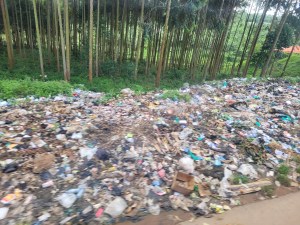
The first thing I noticed in Uganda was how much cleaner it was. It’s not that there was no garbage, we still saw plenty, it was that they, at least, piled it up – and then burned it. The countryside smelled of sweet greenery and burning garbage. In places, we saw people rummaging through the garbage. I don’t know what they were searching for. In places, we still could not see the ground for rubbish. Consider that Uganda is 2.5 times smaller than Alberta but has a population of 12 times more. Would we be better?
There tended to be more agriculture. The weather was warmer. We saw less animals but more crops with a lot of corn, cassava, banana, sugar cane and yams. Never mind a lawn, there was corn planted all around the house.
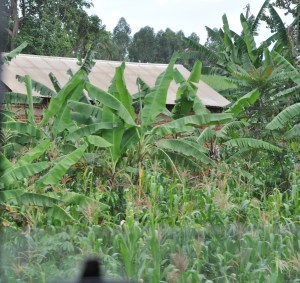
The houses seemed nicer. There were more brick or cement houses. They were small but cute.
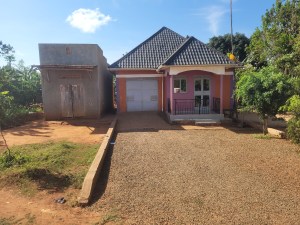
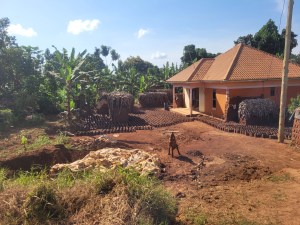
Apparently the British taught them how to make and use bricks for construction. I am sure they taught the Kenyans the same thing, but for whatever reason, the Kenyans tended to buy their bricks rather than make them. Maybe it was the type of soil? We saw lots of bricks being made and dried.
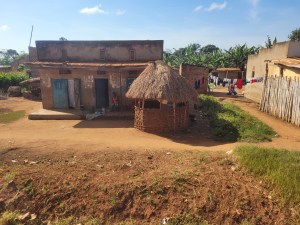
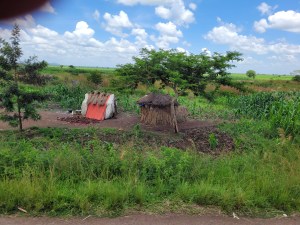
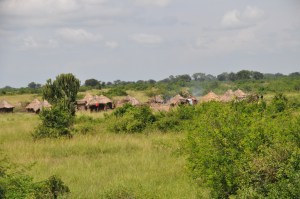
We also saw many small round mud and thatched huts. This was the original style living accommodations and are still used today.
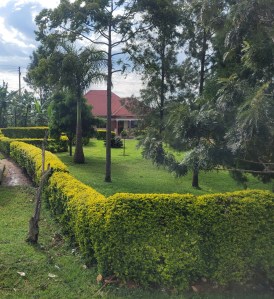
On the flip side, some houses and yards would be the envy of any north American homeowner.
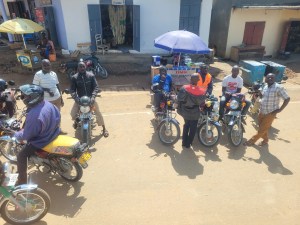
There were fewer men lounging around, although still a lot of motorcycle taxis.
There were more gas stations. Gas was 5800 Ugandan shillings per litre ($2.08 CDN) diesel was 5000 shillings ($1.97 CDN)
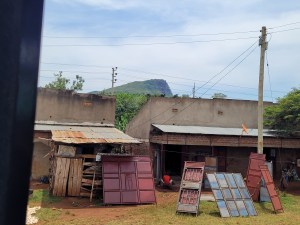
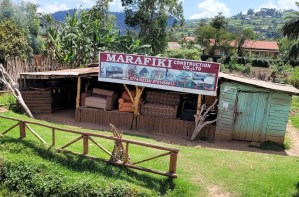
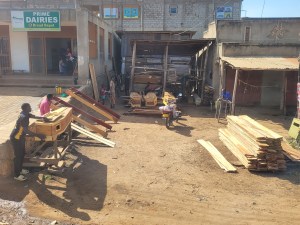
The shops were nicer. They tended to have specialized merchandise on display. We saw a lot of steel doors and windows being made.
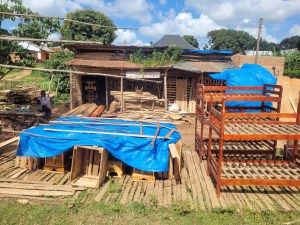
Wooden beds with beautifully carved headboards being made.
Fancy couches and armchairs on display.
Mattresses on display. We passed a solar farm.
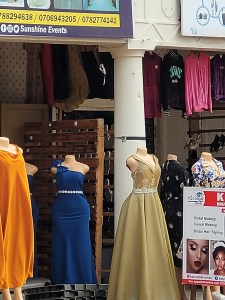
There were more dress shops than in Kenya. The mannequins have large hips.

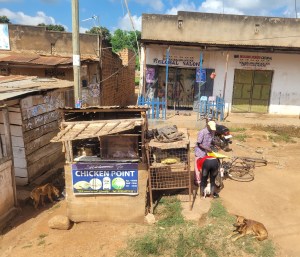
Some shops were no bigger than a phone booth.
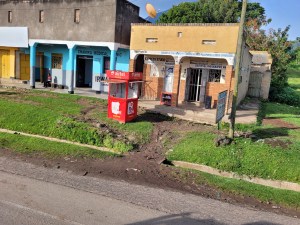
Some towns had five churches in one block. It struck me that the poorer the area, the more churches there were. Some churches were simply tents set up in a vacant lot. Others were small buildings.

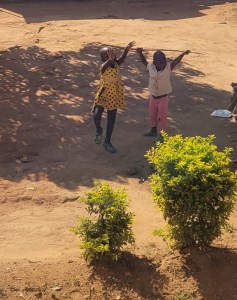
Everywhere we went in our travels, kids ran up to the truck smiling and waving. They were so happy when we waved back. One kid even gave the “Yes!” pull-down with his fist.
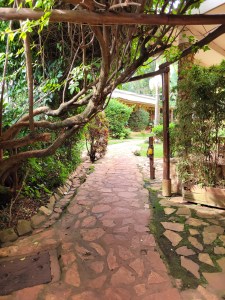
We checked into the 2 Friends Guesthouse and Restaurant in Jinja. (Booking.com has it at $110/night) It had a swimming pool. We were going to be there for 2 nights! Finally, a chance to rest and relax.
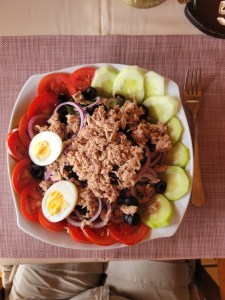
We were told we had to order our dinner by 3:00pm for the 7:30 sitting. I ordered a fish dinner while Sara ordered steak. I don’t know why we had to pre-order, the meals came out one at a time. Martin got his dinner at 9:00. The rest of us were finished eating already. However, the food was delicious. The portions were huge. The cucumber and tomato had flavour like I remembered from the farm. Sara’s steak was the best I had ever tasted. It had a smokey flavour and was melt-in-your-mouth tender. It was big enough to give me a good sampling, she ate her fill, and she still had enough leftovers to save to throw into a salad the next day.
DAY 7
SATURDAY, 22 OCTOBER
A lazy day!
Most of the others went white water rafting. Sara and I opted not to go. It was very expensive and we had already been rafting in the Rockies. It seemed redundant. I met a couple from Germany who were flying home that day. They showed me pictures of places we were yet to visit, which only served to increase my excitement and anticipation.
They told me they had borrowed a friend’s vehicle to tour around east Africa on a self-guided tour. They were leaving the Serengeti at night and got a flat tire immediately after spotting some lions. He said he has never changed a tire so fast in his life. They bought a “new” tire for $100 US. He could see the metal treads showing. He was good-natured and had a good chuckle at his own expense.
Sara lounged in the pool and rotated in the sun most of the day. I read a book.
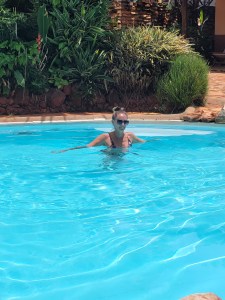
Sue had given me Kevin’s Rolex for safekeeping while they went rafting. Boniface could not, and would not, believe that this watch was worth about $5000. Sara was wearing it while she was showing it to Boniface. Just then, sue came up to me asking for the watch back. I pretended that I had lost it, while Sara and Boniface were chuckling about my joke. Sara quickly came forward to return the watch, ending the joke.
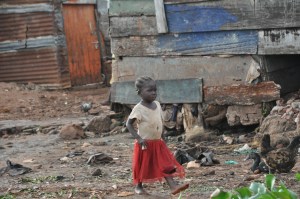
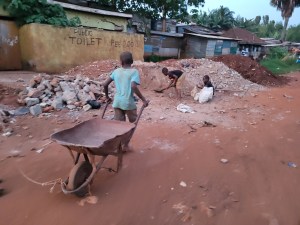
That evening, after our rafters returned, a group of us went on a boat cruise to the head of the Nile. We went to a fishing village on the edge of Jinja and on the bank of Lake Victoria, where we were to board our boat. The village was a shanty town. It was very poor. The buildings were made of whatever scraps of building material they could find. The street was dirt. The kids shabbily dressed. Some kids were playing in the water, naked. Some kids were hauling dirt. BUT all the kids were laughing and waving to us.
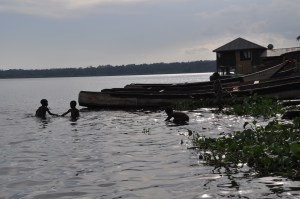
Lake Victoria is the world’s second-largest freshwater lake, after Lake Superior. It covers 68,800 square kilometres. Our guide gave us a brief, and very opinionated, political view of Uganda and Africa, in general, while we chugged along. His opinion was there are over 100 tribes in each country. There are more languages than tribes. Despite colonization and foreign attempts to unite them all, it will never happen. The tribal cultural differences run too deep. And sometimes, as we will learn in Rwanda, the colonizers caused deep rifts when none existed before.
Uganda had 3 million people in 1962 and now has nearly 50 million. Infrastructure cannot keep up. There used to be a lot of east Indians in Uganda, and Jinja in particular. They were brought in to build a railroad in the 1920s. Many of them chose to stay and built lives in their new surroundings. Resentment grew toward them and their thriving businesses and domination of the economy. Idi Amin threw them all out. They left behind houses and shops. Since Amin’s defeat, some Indians are slowly returning, repairing or rebuilding their properties and businesses. However, there are still a lot of abandoned properties rotting away.
We saw 4 fishermen illegally setting nets. They can get 7 years in prison or a million shilling ($360 CDN) fine. They didn’t seem too bothered that we saw them or took pictures. There was a police boat on the water, but obviously ineffectual in capturing these guys.
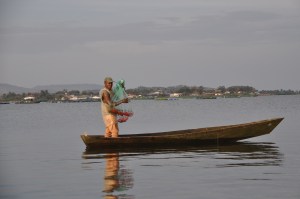
There were 3 prisons within sight. The men’s prison was on one side of a big hill, the women’s on the other side. Across the water, on a peninsula, was the juvenile prison. Children as young as 9 years old can be sent to prison for terms as low as 3 months or for a maximum of 7 years, depending on the severity of the crime. The juvenile prison has a working farm, which they are required to work on. They also receive a trade and an education. In some ways, the kid is better off going to prison than if he had stayed on the street.
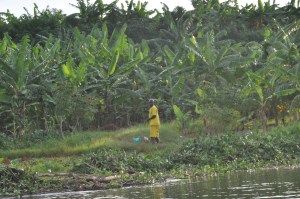
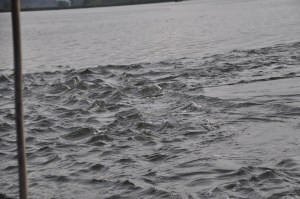
The most interesting part of the cruise was the actual Head of the Nile. There is a spring that feeds the lake/river from below. Although I have not been able to verify this via Wikipedia, the guide told us that the spring supplies 60,000 gallons of water per millisecond. Something was definitely going on! There was a spot right where the lake became the river where water was definitely coming up, quite forcefully, from somewhere deep down.
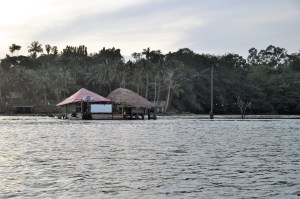
Lake Victoria is also rising. Considering the mass of the lake, it gets fed by a large geographical rainfall-runoff, to the tune of 34 trillion cubic meters per year. Some restaurants that used to be on the shore, are now in the water.
We saw some monitor lizards on the bank, a few birds and a bad sunset (it was hazy).
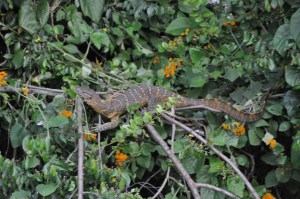
There is also a memorial to Gandhi, near where his ashes were spread into the Nile, as per his last wish.

That night at dinner, a server commented on my smile. Patrick said “She’s not smiling,” The server said, “Yes, she is!” Patrick said “No. I’ve seen her smile bigger!”
DAY 8
SUNDAY, 23 OCTOBER
We had to hit the road very early. Patrick said we needed to miss the rain otherwise the road we were taking becomes impassible. It allowed us a 3-hour shortcut to our final destination. As it was, it still took us nearly 9 hours.
We drove along a very dusty dirt road, through many, many tiny villages and past rustic farms. I found the countryside fascinating. This was authentic life, where people lived off the land in a traditional manner.
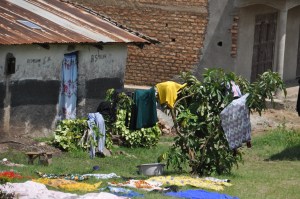
Everywhere we drove there were women washing clothes in a wash pan or the laundry was already hung across bushes, on clotheslines, or laid out on the grass. Considering how dusty the roads were (even the plants were covered in dust) I am not sure how clean the laundry was at the end of the day.
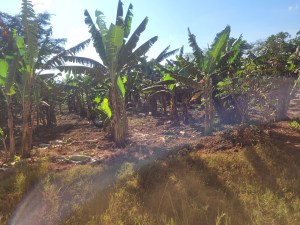
We saw lots of bananas growing. Bananas produce fruit 14 months after planting, then the plant dies. It is cut off and from the stump, a new plant grows. Every part of the banana plant is used. The leaves serve as plates or as wrapping for cooking food. The bark is used as a water pipe. The middle of the stock is used for cow food. Nothing is wasted.
There was lots of coffee drying on huge tarps, as well.
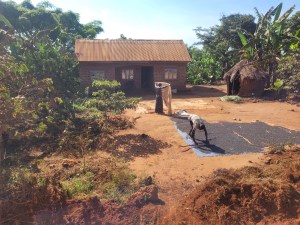
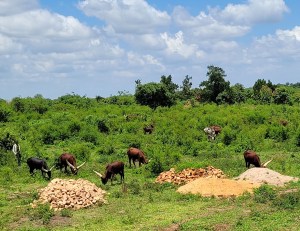
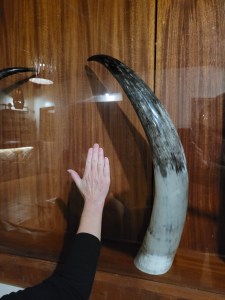
Some villages were made entirely of the round mud huts I mentioned earlier. We saw herds of big-horned cattle. The horns were so big I could have stuck my entire arm inside of one and still had room to spare.
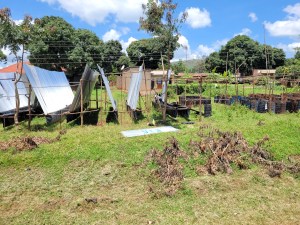
We passed through a village that traps and sells grasshoppers. During the rainy season and full moon, the grasshoppers tend to come out in full force. Sheets of metal are supported against wooden scaffolding. Below the angled metal sheets sit dozens of empty oil barrels. Above the metal sheets are bright lights, enough to light a small football stadium. The lights come on at night, reflecting off the metal sheets and attracting the huge, green grasshoppers. The grasshoppers get trapped in the circle of lights. (Stay away from the light!!) Fresh grass is set on fire to create smoke, which stuns the insect, and they slide down the metal sheets and drop into the waiting barrels where they are collected into sacks. They are then sold to be boiled or a deep-fried crunchy and salty snack. A cupful can sell for 5000 Ugandan shillings ($1.80 CDN), making a sackful worth over $100 CDN. Even with a declining grasshopper population, a harvester can earn nearly a month’s worth of wages in a single night. Yes, the grasshopper population is declining, due to deforestation – their natural feeding and breeding habitats. It was common to collect 20 sacks a night; they now collect two or three.
Everywhere we went on our travels, we saw massive termite mounds. They were spread across the savanna, in the middle of crop fields and along the road. They are huge and as hard as stone. Little islands of trees and shrubs take root around the mounds. Birds sit on the mound to rest and eat termites. The bird poops, which has seeds in it. The seeds take root, which attracts more birds. Eventually, the shrubs and trees grow bigger and suck up the moisture surrounding the mound leaving the termites without a proper water source. The termites leave and the trees stay. We saw areas that were completely reforested in this manner. Some parks do controlled burns to slow the process, but nature always prevails.

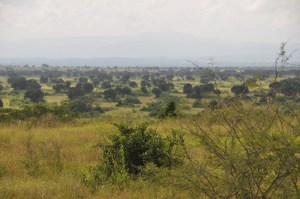
We stopped at the entrance to Murchison Falls National Park for a boxed lunch and to get our permit to enter the Park. There was a small gift shop located there, as well. Kevin didn’t want Sue to linger after lunch for fear that she would go crazy shopping in the curio shop. Just then Patrick said we were ready to go. Kevin held out his hand to help Sue down the steps. She said “Why are you holding out your hand? You never hold out your hand.” We all burst out laughing and had to explain that he wanted her OUT of the shop.
The forest was so dense along the road that it was impossible to see past the first tree. There were so many vines that the trees looked like they were draped in silk.
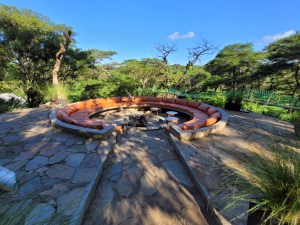
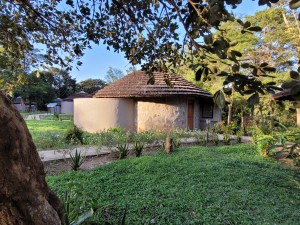
We arrived at Sambiya Park Lodge. It was another beautiful lodge rated on Booking.com at $172/night. We were taken down a path to a large round fire pit that was surrounded by a larger round sitting area and offered freshly squeezed watermelon juice. Yummy. Off to the side was a suspension bridge over a small valley. The Lodge was built to resemble the traditional round mud huts with thatched roofs, that we saw so many of along the road.
Our cabins were also round and had outdoor showers.
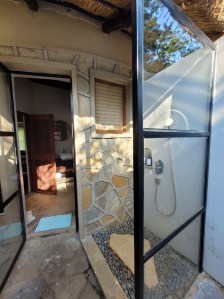
There were 3 outdoor pools, which nearly everyone took advantage of that evening. It was absolutely refreshing after the long dusty trip.
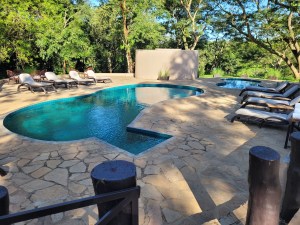
NOTE: Smoking was NOT allowed anywhere if there were thatched roofs nearby. We were told that a lodge actually burned down because of a rouge cigarette. Thankfully, it was not an issue for us as no one in our group smoked.
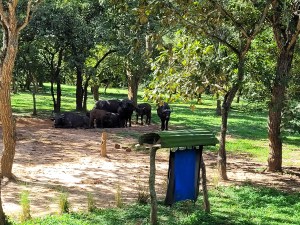
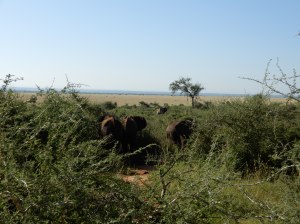
We were cautioned that a small herd of cape buffalo likes to graze on the property. We were to give them a wide berth if we saw them. We saw them every evening. We also saw warthogs grazing in the valley.
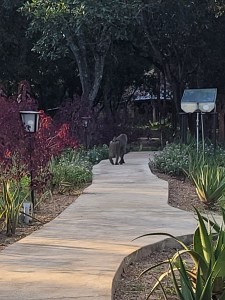
The next day, a baboon was just outside our room, as I exited. If we heard the baboons shrieking all night, that meant there was a leopard nearby. We could only hope. We had yet to spot one. Electricity was by solar or generator. We were to have power from 6:00-8:00 am and 6:00-10:00 pm, but it was spotty at best.
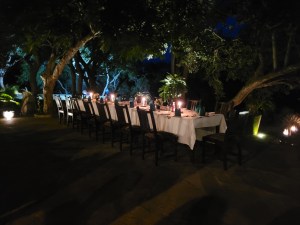
That evening we ate dinner outside, under the trees and stars, with candles on the tables. It was magical!
DAY 9
MONDAY, 24 OCTOBER
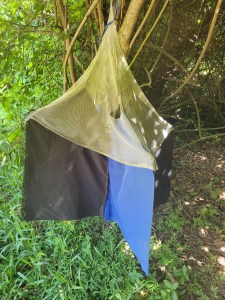
We had another early morning start. We were off on another game drive. We were told to wear lighter clothing as tsetse flies are attracted to black and dark blue. Patrick said he was screwed no matter what colour his clothing was. One must be bitten many times in order to get the sleeping sickness they carry, but the bite would still hurt like a horsefly bite, from what I could gather. There were tsetse fly traps set up in the bushes around the lodge.
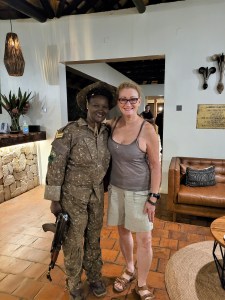
We picked up Ranger Vivian as a guide and were off. Murchison Falls National Park covers 3890 sq km and has 1000 rangers. Vivian told me that rangers are trained in the military first, then go on to be rangers. They can be called to military duty at any time. She added that one has to be brave to be a ranger. One has to be able to stand in the face of danger and not be afraid. I asked if her husband was also a ranger. She laughed and said, “I told you, one has to be brave to be a ranger. I am brave. He is not.” She was an absolute badass. She was a corporal and seemed to bark orders at the other rangers, who jumped when she did. She was a very informative guide. Much of the information I have throughout this blog is a result of her.
SIDE NOTE: When humans fight, animals suffer too. During the civil war in Uganda, many animals were killed for food by both armies. Many animal populations are only now recovering.
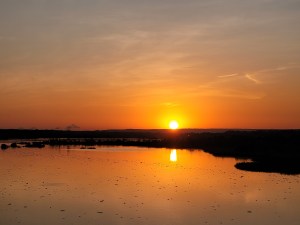
As we were crossing the river, we stopped on the bridge for a few minutes to watch the sunrise over the Nile. It is hard to put into words the emotions of such an experience.
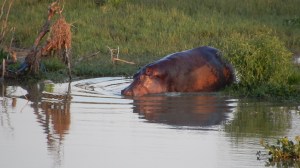
As were about to pull away we saw a hippo entering the water.
We didn’t see many zebra as they don’t like tall grass, which was 3-4 feet high in places. This would allow lions to sneak up on them easier.
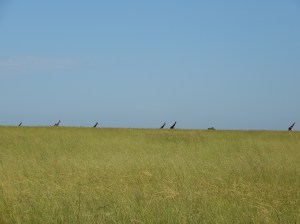
We saw towers of giraffe and leopard footprints, but no leopard.
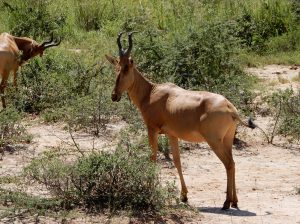
We saw lots of hartebeests, with their long thin faces.
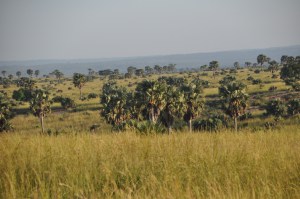
All of the palm trees we saw were not native to Uganda. They were brought in via elephant poop from other countries.
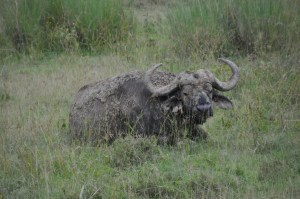
We saw lots of cape buffalo. They have poor eyesight, but have a good sense of smell and tend to be cranky. Young male buffalo chase off the older males who can no longer defend the herd. The old males form their own group as a form of protection. Because they are outcasts, can’t see well and are old, they tend to be VERY grumpy and tend to attack more easily.
We saw lots of Uganda kob, another type of antelope. The males will stand and face a lion while the females run away. He sacrifices himself for his harem. The age of the kob is determined by the number of rings on his horns.

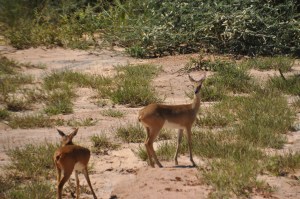
We saw a small group of oribi. They are small antelope and run VERY fast; their body literally goes flat when they run. They are clever animals that will poop in one spot and eat farther away, to fool the lions. They have a black spot on the side of their head that lets off a scent to mark their territory.
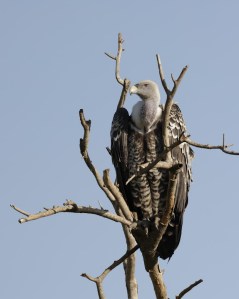
We saw a vulture in a tree. We also saw a wake of buzzards circling in the sky.
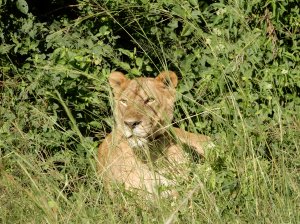
a pregnant lioness with a radio collar. She was resting under some bushes. A fellow in the jeep behind us got out of his jeep for a better picture. She perked up really fast when he got out. NEVER get out of your jeep unless instructed to.
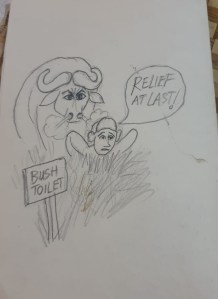
About 100 meters later one fellow must have really needed to use the toilet. He ran into the grass and dropped his drawers, oblivious to the two tour trucks that were coming from either direction.
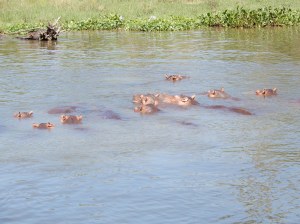
We were heading to a body of water, where we had a bathroom break. The nearer we got to the water, the more animals we saw. There were hippos in the water
and warthogs nearby.
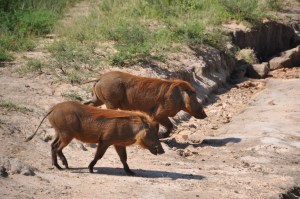
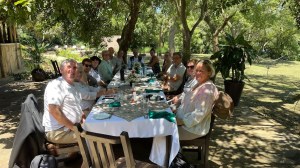
From the game drive we headed back to the lodge for lunch, under the trees again and then onto the Nile where we boarded a boat for a river cruise.
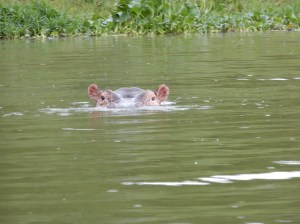
From the boat, we saw lots of hippos! We heard a group of hippos called a herd, a raft, and a pod. According to Wikipedia, they are a bloat of hippos. Every time we saw some the boat captain would cut the motor and we would glide past them so they don’t become agitated and learn to hate boats. Hippos kill 500 people a year (the beloved dog kills 30,000 – yet we let them sleep in our bed….) I asked the captain if he ever had a hippo attack his boat. Yes! Although the boat is big enough that the passengers were not in harm, it was scary. He found out later that this particular hippo had lost her baby and was angry at the world. The other boat drivers learned to give her a wide berth until she settled down.
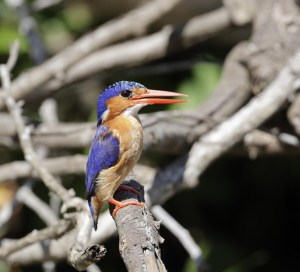
the colourful Malachite kingfisher bird
the red-throated bee-eater bird with its nest built into the cliffs
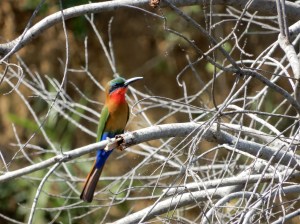
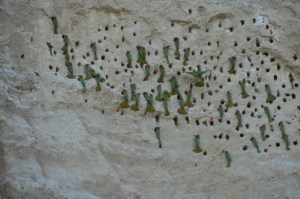
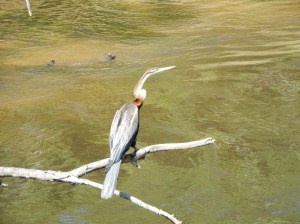
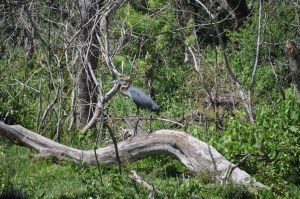
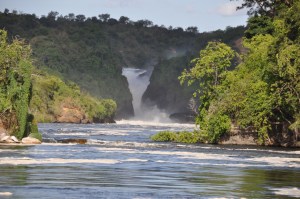
We got as close to Murchison Falls as was safely possible. Even from a distance, we could see the power and force. More about the falls tomorrow, when we went to the top of them.
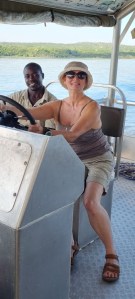
On the way back, the captain let me drive the boat for a while. As I did we chatted about tourism. He said that business has doubled post-Covid and looking at reservations for 2023, they will double yet again next year.
DAY 10
TUESDAY, 25 OCTOBER
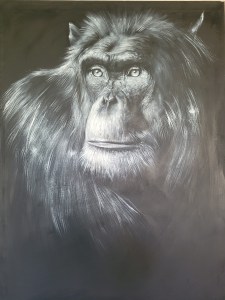
CHIMPANZEES!
We took the truck to a lodge where we picked up 2 guides, got a briefing then drove for about 6 minutes, where we got out and started trekking. As the guide said, we can trek for 2 hours through the jungle or drive a few minutes to save time. Since we were only allowed one hour with the chimps, we opted for the drive. As it was, we trekked for about 6.5 km, which took 5 hours anyway.
We made our way through the jungle listening for chimps. The guides “communicate with each other with hoots and whistles, similar to the chimps, letting each other know where they are. We could hear the chimps before we spotted them. They live in families of 70-100 and “talk” to each other with VERY loud hoots and howls. It is rather scary. You cannot see them, but you can hear them all around.
Most of the chimps were in the trees – or maybe it seemed that way because they were easier to see and hear. We all got sore necks from looking up. The chimps sit VERY high in the treetops, eating and spitting. When they decide to leave the treetops, they swing from branch to branch, on their long arms, and within a few seconds they are on the ground where they silently vanish into the brush.
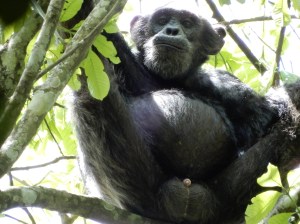
On the ground, they are nearly impossible to spot in the underbrush and they moved so quietly it made it even harder. In the trees, they crash about a bit. When the guides did spot them on the ground they were so well hidden it was nearly impossible to see them. But when we did finally make them out, we were a bit shocked to see them watching us, as closely as we were watching them.
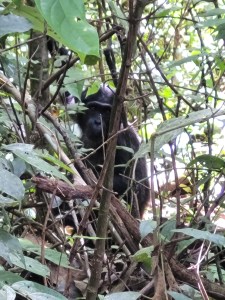
Sara got off a good shot of a baby chimp.
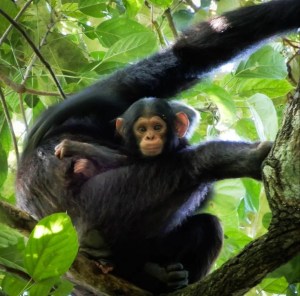
Males stay in the same group for life. If they go to another group the other males think they are going to steal their females. Females, however, can and do move to other groups. Sometimes they stay. Sometimes they just get bred and then go back to their original family. They will breed with multiple partners. All the males think it is their kid and protect the mother and baby. Males stay with their mothers for 8 years. Females stay for 12 years and then start to breed.
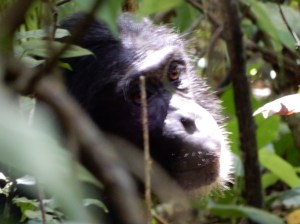
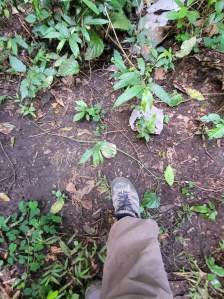
The trek wasn’t hard except for thin vines that kept tangling in our feet. I got lots of scratches from thorny vines.
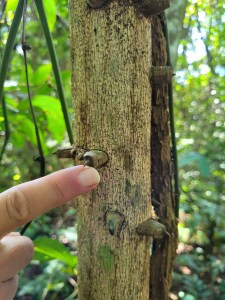
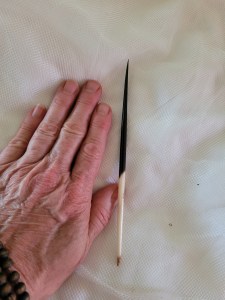
Sara found a porcupine quill.
We went back to the lodge for lunch. A word about the hotel meals in Africa: They had a weird system of requesting we pre-order our meals. They would ask how many wanted this dish or that dish and mark the number down. On this particular day, Sara and I left the breakfast area before they took a meal count. As a result, they had to scramble to come up with food for us at lunch. We were the only group staying there. One would think that if 18 people register for rooms, 18 people would show up for lunch – especially since we were all together. Sometimes they got so ahead of themselves that they would bring out the food before the person who ordered it arrived. We would tell them that Mandy, for example, was still in her room. They would set the meal aside until she arrived. This included cornflakes with milk, left to get soggy or hot meals to grow cold. That said, every hotel had hot soup that was absolutely delicious. We quickly learned not to pass up on the soup, despite how hot the day was.
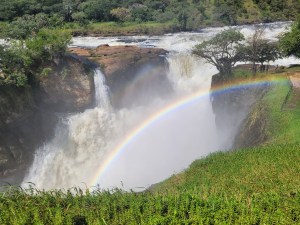
After lunch we went back to Murchison Falls, but this time to the top of the falls. It was beautiful! Ferocious! Breathtaking! 80,000 gallons of Nile water push through a 6 meter chasm to drop 50 meters.
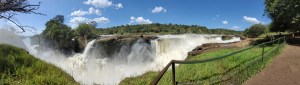
We went up a slippery set of steps to look down on the scene. The mist created a rainbow.
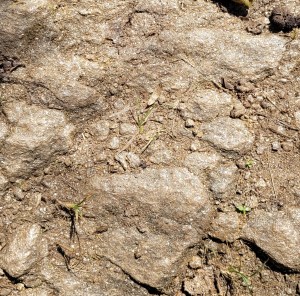
The rocks on the trail seemed to sparkle. Patrick explained that it was dolomite that gave it the sparkle.
That evening 6 of us decided we wanted to take a night safari. We were told it would work out to $60 US each. OK. When it came time to pay, it turned into an absolute gong show!
The lodge would not accept any US bill with the slightest blemish. They said they get a reduced exchange rate at the bank if it is blemished. In Ugandan shilling, they wanted 237,000. No one had enough shillings. They said that maybe we could pay part shillings and part US dollars. That was still no help. Susan and Kevin finally loaned me the shillings. Vicky helped Sara with exchanging better US notes for blemished ones. It took us a long time to sort the payment out.
Vivian was, again, our guide. On the way, just a few kilometres from the lodge we saw five huge elephants grazing in the ditch beside the road. Further on, we saw a tower of giraffes. Once in the Park, it got dark quickly. Vivian was standing at the back of the jeep, shining her huge spotlight back and forth in hopes of seeing an animal.
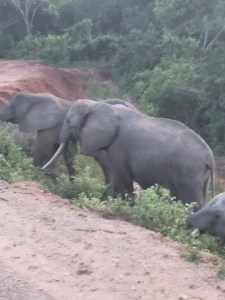
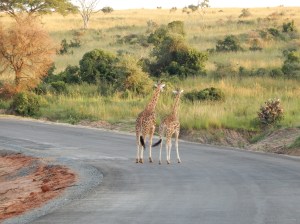
A mongoose was on the road in front of us, racing for his life and kicking up dust as he went. It was cute. He finally darted into the tall grass.
We finally saw a leopard!! We probably would have missed it except another jeep was stopped and shining its light into the grass. There was a lion on the road in front of us. Our driver was focused on the lion while Vivian was yelling at him to stop so we could see the leopard. I was in the front seat with the driver and he kept pointing at the lion while I was trying to video the leopard. I finally told him we had seen many lions but NOT a leopard. oh….. The driver was fixated on spotting a lion for us. He excitedly pointed out huge lion tracks on the road. I pointed out they were going the wrong way. Vivian pointed out that they may be tracks, but it was not a real lion.
We could hear lots of night sounds, mostly insects. The stars seemed very close and bright. We were out for about 5 hours. Considering we noticed that the engine light was on the entire time, the steering wheel was off kilter and needed a wheel alignment, it had a bad shimmy and smelled of raw diesel, I think we did OK.
As we headed back to the lodge we saw more animals on the highway than we did in the Park. The reason is that rain washes off the highway and causes the grass to grow in the ditches. The highway also retains heat. Combined, this causes animals to converge there to eat. I am used to watching for deer or gophers on the roads in Canada. Here, we saw elephants, giraffes, hippos, a jackal and a hyena. Hippos and elephants are huge! Much heavier than our jeep! And they kind of take up the entire road. When the hyena jumped out of the ditch, my Canadian mind was thinking “Coyote?” too small. “Bear?” wrong shape. “What the hell IS that?” All in a nanosecond.
Check out Sue’s Night Game Drive Adventure in another blog.
DAY 11
WEDNESDAY, 26 OCTOBER
We had to get up real early to hit the road before it rained, again. No electricity in the room. Not good when you are trying to pack to leave. Good thing we sort of packed before our night safari, as there was no electricity when we got back last night either.
We had to drive 3 minutes to the middle of an intersection (???) to get a connection for the credit card machine to work for those who had to pay for extra billing stuff (drinks) Bizarre!!
This day we saw children picking weeds in the schoolyard with hoes and brooms. Were they teaching kids not to litter and to care for their environment? We drove by acres of fuzzy papyrus plants.
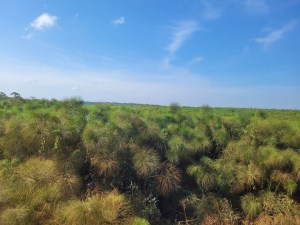
I saw a little kid, not more than 2 or 3 years old, carrying a machete that was longer than he was tall. I saw a young girl carrying a baby, in a sling, on her back. Was it her child or a sibling? I saw a half-built house with no roof that had corn growing inside. I noticed there were hardly any dogs or cats. All the women wore dresses. We stopped for gas in Hoima, which has a strong military presence. We saw dozens of men handcuffed together.
There is a lot of Chinese writing on buildings. The Ugandan government borrowed billions of dollars from China to build roads and other infrastructure. Some of the roads have tolls to raise money to repay the Chinese.
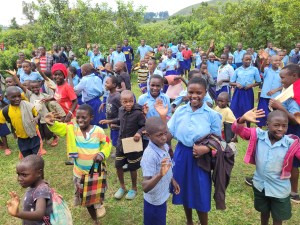
We stopped for our box lunch in a schoolyard. We were just finishing eating when the kids let out for their lunch break. We were surrounded by hundreds of smiling, happy, cheering kids. They wanted their pictures taken. Some of them were touching our white skin and fair hair. It was such a joyful experience on both sides. As we were pulling away the kids were chasing after the truck, still cheering and waving. Patrick finally had to tell them to stop as he quickly jumped into the cab.
We drove through miles and miles of tea plantations. They were left by the British and have since been converted to co-ops for the local people. We saw some amazing houses in this area. These tea crops are harvested by machine, giving the tea a lower quality than tea that is picked by hand – two leaves and one bud. Tea can begin to be picked 2-3 years after planting. The plant is cut down after 8 years to generate new growth. Plants can live up to 30 years.

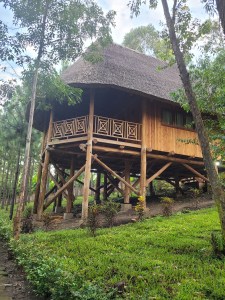
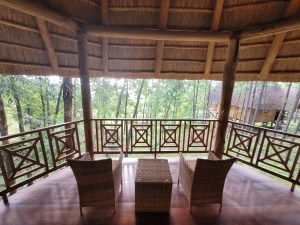
We checked in to the Parkview Safari Lodge. We had our own cabin the size of a small house. It had a huge deck that overlooked the Rift Valley. It rained HARD that night.
DAY 12
THURSDAY, 27 OCTOBER
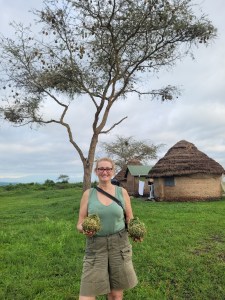
We went on another game drive, this time to Queen Elizabeth National Park. While we were waiting for our entry permit I was talking to a fellow about the weaver birds. These cute little yellow birds build their nest upside down. Well, the males build the nest – in hopes of attracting a female. If she likes the nest, fine. If she doesn’t like it, he tosses it to the ground and builds another one. As the fellow told me, if he built a house for a lady and she didn’t like it, he was more likely to toss her out!
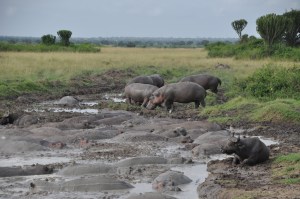
Because of the previous night’s rain, there were mud holes all over the place. Each mud puddle seemed to have hippos in it. Some only had room for one or two. One had over 30 grunting, snorting, muddy beasts. There used to be over 30,000 hippos in this Park, they were down to 5000. I am not sure of the reason.
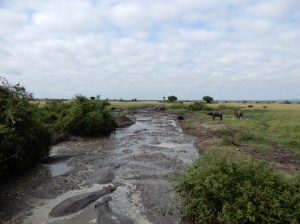
The scene was boring yet fascinating, all at the same time. The hippos didn’t do much, other than grunt and reposition themselves. Several other hippos were meandering closer and eventually found a spot to wallow along side the others. Cape buffalo lazed beside the mud pond, as well.
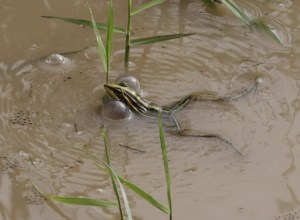
On the opposite side of the road, little frogs were croaking away. For the noise they created, we were surprised to see how small they were.
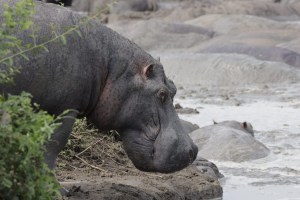
There was also a hippo on that side of the road. It gave us a little show of spreading its poop, as a sign of agitation then meandered behind the truck and crossed the road to the mud puddle side. Males can weigh 6000 pounds (2720) kg, and the more delicate females can top out around 3000 (1360 kg) It is hard to believe this lumbering beast can run 30 mph (48 kph). It disappeared behind a bunch of bushes and we kind of lost interest. A couple minutes later it popped out from behind some bushes. How can such a huge beast POP out? Well, it did! It gave us a good reminder of how animals can sneak up on someone who’s not paying attention.
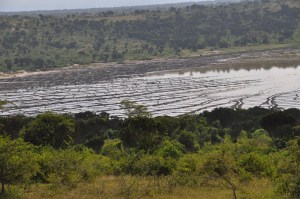
We stopped for a bathroom break at a small market. They were conveniently located on a high hill overlooking a volcanic crater lake where salt is harvested. Lake Katwe?? Water drains in but cannot drain out. Evaporation leaves behind a salt solution. Harvesting salt is not easy, in fact, it is dangerous. The salty is water is so toxic that men wear condoms so as not to get their private parts affected. Women put flour in their private parts for the same reason. The infertility rates are high in this area. The cleaner salt is sold as table salt, the muddier salt is used to cure meat.
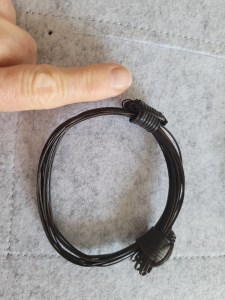
I bought a dress ($15) and an elephant hair bracelet ($5). As soon as I saw the bracelet I knew what it was. When I was in elementary school, our principal spent a year in Africa as an exchange teacher. When he returned he had stories and slides to show the school. I remember he had a unique bracelet. It was not common for men to wear any kind of jewelry back then. I asked him about it and he said it was made from the tail hairs of an elephant, and he let me hold it. It made a huge impact on my young mind. Therefore, I recognized it immediately, and had to have it! Thank you, Mr. Skuba, for instilling a sense of wonder into my life.
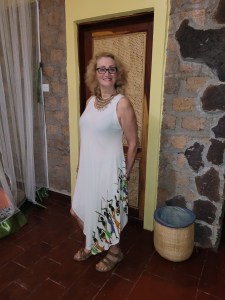
We didn’t see many more animals this morning. This park does not have zebra, giraffe or rhino.
We headed to the Kazinga Channel, a 32 km long river between lakes George and Edward. We were going on another river cruise.
We saw a herd of elephants running. The male stopped to look behind, then they all took off again. It was all very curious and exciting.
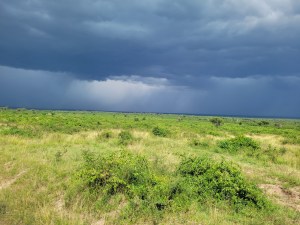
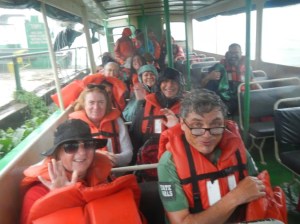
On the way, we saw ominous storm clouds in distance. 15 minutes later, just seconds after getting onto a metal boat, on the water, a horrific wind blew the hat off my head (a man caught it) A minute later it started to rain and every moment it rained harder. It was raining sideways into the boat. The boat was rocking, the waves were getting higher. There was thunder and lightening all around. We were still on the boat. The captain and crew kept assuring us this was a temporary rain. “See, it is already blue skies over there.” No, that’s blue storm clouds.
We got soaked, some more than others. Most sat on the leeward side of the boat. Life jackets protected us a bit. In the end, I could wring the water from my shorts leg. Even Chris, the navy guy, said he was judging just how long it was safe on the boat. The rain diminished and we headed out on wet seats. There were flaps that came down around the boat but they were so full of holes it would have been pointless. One flap came down in the wind.
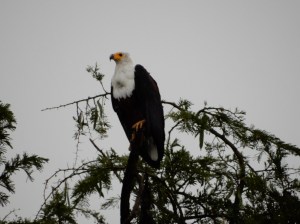
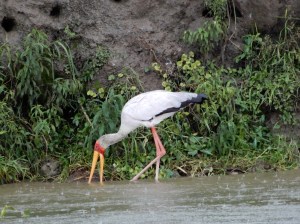
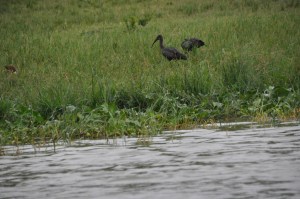
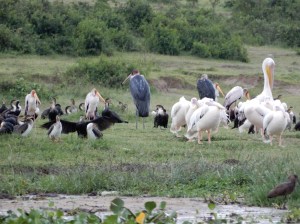
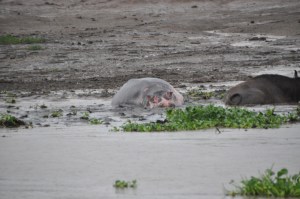
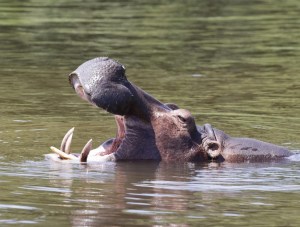
We saw LOTS of hippos, even an albino hippo, and a few crocodiles.
Hippos cannot swim. They bounce along the bottom of the water similar to an astronaut on the moon.
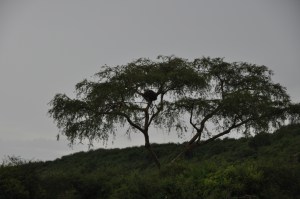
Hamerkop birds are often associated with witchcraft and the occult. They build a HUGE nest in the fork of a tree. The nests can weigh up to 50 kg and have been known to topple the tree from their weight. They are like a magpie in that they decorate their nests with lots of trinkets. Since most of the trinkets are of human design, it is believed that the bird collects these items as a way of casting a spell on the human. If one of these birds lands on your house, it will bring you bad luck and you had better move!
We saw several waterbuck. Waterbuck have to live near water. Their meat is rather saturated with water and lions will only eat them if they are really hungry. Another deterrent for the lion is the waterbuck can release a scent gland if it is startled which ruins the meat. Lions need to really sneak up on it to kill it. Their form of halal, I guess.

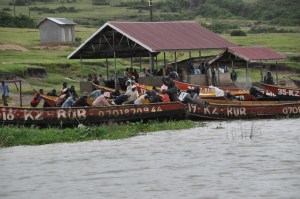
As it was beginning to get dark, we passed a fishing village where they were launching their boats. Hippos leave the water for the night, so it is safer for the men to fish and not be surprised by a hippo. The village was full of cape buffalo. The men walked past like it was no problem or threat.
We came upon an elephant entering the water right in front of us. It didn’t seem the least bit bothered by us and waded out to a shrub where it proceeded to eat. We watched, fascinated, only meters away. I think we would have sat there for the rest of the journey had it not decided to go back to shore on its own.
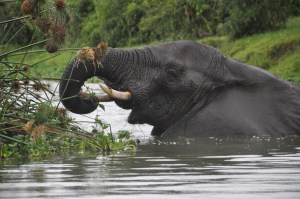
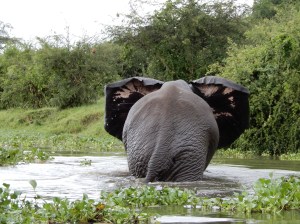
Back on shore, we had to walk up a long hill to get back to our truck. Boniface had to move uphill before the road became so slick we would have been stuck at the bottom. On the way, I saw many lovely plants, bushes and flowers.
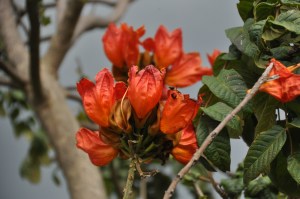
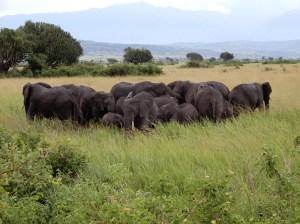
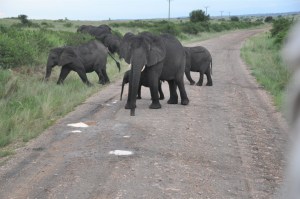
The drive back to the lodge was laid back. We were all tired and pleased with ourselves for seeing so many hippos and that close-up elephant. Suddenly we spotted a family of about 25-30 elephants right beside the road. STOP THE BUS! There were lots of babies and juveniles. The adults formed a protective circle around the little ones. They moved in unison, eating as they went. They started to cross the road behind us. Some of the bigger elephants were raising their powerful trunks in the air, sniffing us. One looked like it wanted to challenge us. A young one was having problems climbing over the ditch embankment and Momma had to give him a nudge with her trunk. Two young males started play-fighting. Patrick asked if we were good, time to move on? NOOOO We all shouted back! Eventually, the family walked off, literally into the sunset. I had tears in my eyes. How majestic! How beautiful!
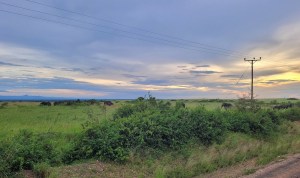
The village we passed through to return to our lodge has water bottle fences around young trees to protect them from elephants.
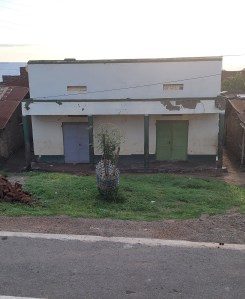
There was also a military camp set up just outside the village that was entirely mud huts.
DAY 13
FRIDAY, 28 OCTOBER
I have mentioned how the Lodges were lovely, but they had a different way of doing things. And I’m not sure they are a better way. We got up in the morning and stuck our heads out the door to see what the weather was like. Two staff were standing there waiting to carry our luggage. We weren’t even dressed yet. How long had they been standing there? How much longer did they intend to stand there? It gave us the creeps.
I went to get a glass of juice and all of the glasses were gone. I asked one of the staff if she could bring me one. I could see into the kitchen. She grabbed a glass almost the second she walked through the doorway but then disappeared further into the kitchen for a few minutes. Where was she? When she finally came out, my glass was on a plate.
We hit the road but had to make a stop in Kabale for Sharon to see a doctor. Her hands and face were terribly swollen from mosquito bites. While she was at the doctor’s we looked around a market a bit. We saw potato chips in the weirdest flavours like tangy lemon, pizza, fruit chutney, chicken, tutti fruiti and pizza. We stocked up on some snacks (not the tutti fruiti crisps, though) It didn’t take her long, and we were on the road again.
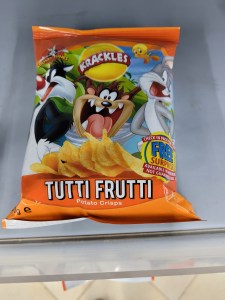
We passed more tea and cotton farms.
A common sight along the road were houses and shops padlocked shut. I would guess up to 60%. Apparently, when people leave to find work or for other reasons, they simply lock the doors.
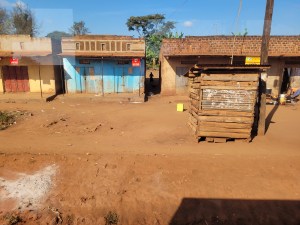
Patrick wanted to buy us some red bananas. We had never heard of them before. We stopped at a market where he knew they were available. Instantly, a dozen women came charging forward with baskets of bananas.
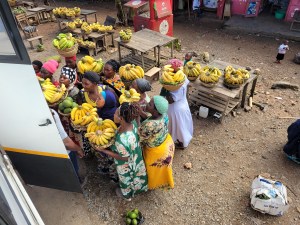
Eventually, he found RED bananas. The other ladies seemed deflated.
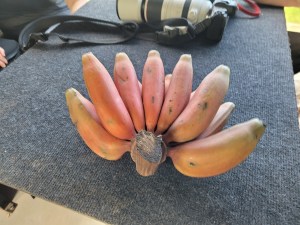
The red bananas were shorter and fatter than regular yellow bananas. The flesh was also a slight pink colour and was much meatier. All in all, I would switch to red bananas, if they were available in Canada.
Paul called through the window and asked if it were possible to get some avocado. The banana baskets were suddenly replaced with baskets of avocados. I think if we had been looking for coconuts, they would have suddenly appeared.
We stopped for lunch in a vacant lot beside a hotel. The hotel’s doors were old license plates.
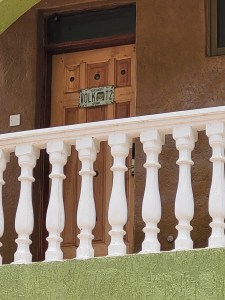
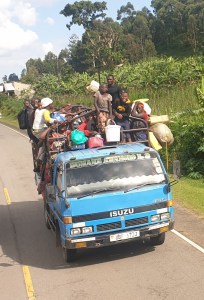
We met truckloads of workers.
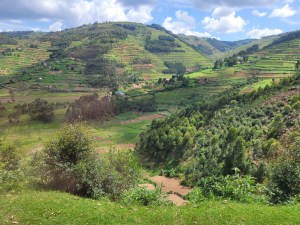
We went into the mountains. There were lots of switchbacks. The countryside was very hilly. They were filled with a mosaic of crops. We could see metal roofs gleaming in the sunshine all the way up every hill and mountain.
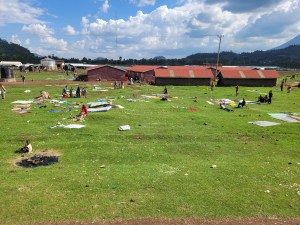
We passed a Congolese refugee camp. From this area, they can hear the bombs going off across the border in the Democratic Republic of the Congo. Families were evacuated to Uganda.
Kids were rolling tires with sticks – a common sight across our travels.
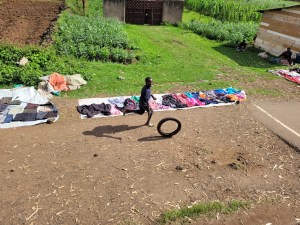
When we were leaving a few days later, there were big trucks hauling the people back to their homes. I can only hope they had homes to return to.
We stopped for a photo opp with Mt. Muhabura in the background. It is a dormant volcano and the 8th highest mountain in this range and home to a National Park with gorillas.
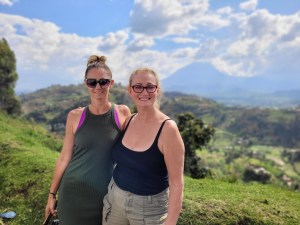
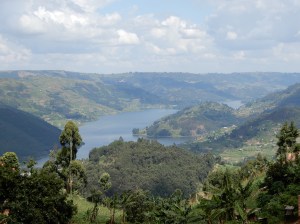
We stopped for another photo opp at Lake Bunyonyi. The islands are home to the local pygmies.
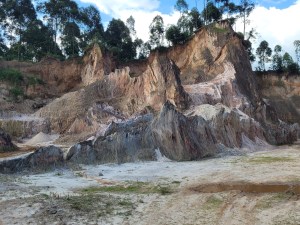
We passed a sand quarry.
There were little kids in shabby clothes, in the middle of nowhere, carrying wood on their heads and lugging water jugs. There were no adults around, they seemed as common as the many baboons we commonly saw along the roads. Even though we saw schools, but I still wondered if these kids had ever seen the inside of one.
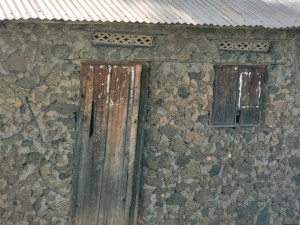
We passed villages with field stone buildings. Somehow, they reminded me of Hansel and Gretel.
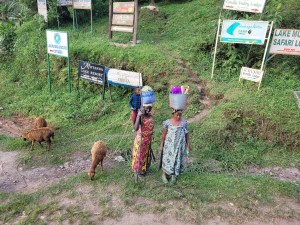
We saw a lady with a baby on her back and a hoe in her hand. We saw ladies carrying baskets on their heads.
There were mountains of bricks being fired.

We finally arrived at Lake Mulehe Gorilla Lodge. The road was too narrow and steep for our truck. We had to get out and walk that last quarter mile. A jeep collected our luggage for us.
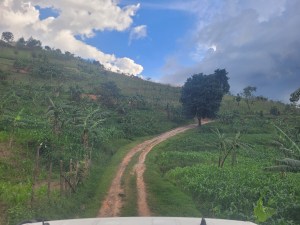
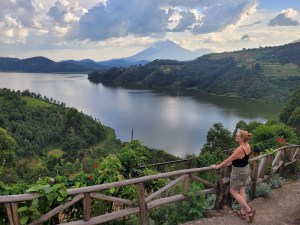
This was another beautiful lodge. It overlooked Lake Mulehe. The quality of these lodges and their locations of these lodges still amazes me.
That night the staff put hot water bottles under the covers. What a cozy night!
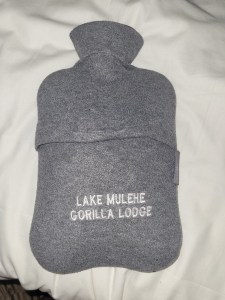
DAY 14
SATURDAY, 29 OCTOBER
GORILLAS
We were up early and on the road by 6:00 am. I don’t think anyone really slept well in anticipation. It was foggy that morning. We laughed – Gorillas in the Mist. The road was bumpy, but we didn’t mind. We were going to see the gorillas!
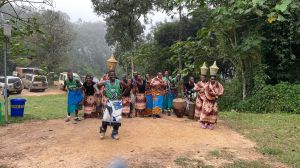
We arrived at Bwindi Impenetrable National Park. We were entertained by some local dancers. We were told to expect them and to have tip money available. Initially, we all had a little money set aside for them, but after the performance they put on, everyone gave a lot more.
After the dancers, we were given an orientation about the gorilla protocol. Do NOT run – no matter what. Do not look them in the eye. A ranger was to lead us and another ranger would follow. Each had the “popular and famous” AK47. The gorillas we were going to see had been habituated, meaning they were used to humans. It takes months of work with rangers sitting quietly nearby until the gorillas get used to them. There were other bands of gorillas not habituated, as well as elephants and other predators. The rangers would not shoot to kill unless absolutely necessary. Generally, a shot to the air is enough to scare them off.
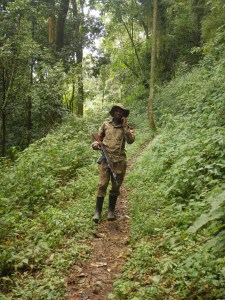
Last night at the lodge, we were advised to hire a porter. They can carry our bags and cameras and help on the trail. Most importantly, they are former poachers. The Government made a deal with them that if they stop poaching they could be hired as guides. They work on a rotating number system. A guide was only $20 US. A cheap price to pay if it keeps them from killing gorillas. We hired Adrienne. She didn’t strike me as a poacher, but then again, I never asked. She said she has one child, takes care of 2 more “needy” children and operates a farm. They eat what they grow; there is not enough to sell. Another good reason to help support her.
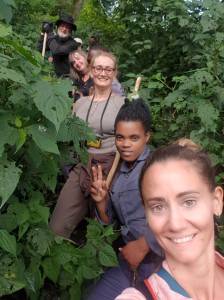
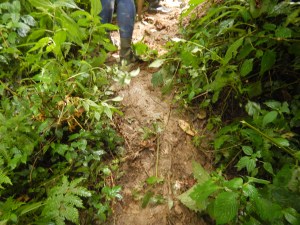
We were broken up into small groups, given walking sticks and off we went. The sticks came in VERY handy when climbing some of the hills. We started off on a trail for about 90 minutes. The rangers keep in touch with the trackers as to where the gorillas are. Our ranger suddenly said that our gorilla family had been spotted and we were leaving the trail in order to take a shortcut. The shortcut consisted of a cow-path trail down a 45-degree embankment that dropped 50 meters. We were hanging on to branches and roots to keep from losing control. Our shortcut took another 90 minutes.
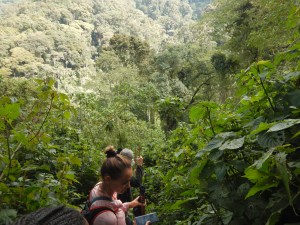
We could hear them before we saw them, Unlike chimpanzees, gorillas are noisy. They have no natural predators, except humans. Sara started whacking me on the chest whispering LOOK LOOK LOOK!
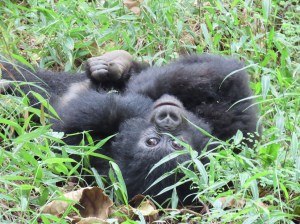
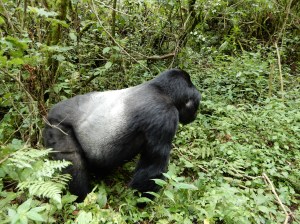
I saw one moving and started to video. Suddenly a 240 kg silverback came out and sat right in front of us – 2 meters away. the Ranger made us move 10 meters away. We were surrounded by them. The Silverback, mom and baby on one side. Mom and juvenile on the other.
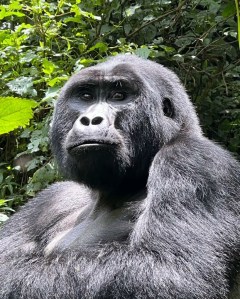
Something startled the silverback and he came charging right at Sara. Just by chance, she caught it on video. It didn’t seem like he was moving fast in the video, but you can see he speeds up at the last second. I was right beside Sara and when you have something that big, and wild, charging at you it IS FAST. It shouldered Sara, moved on about 10 feet then stopped. I had NO time to react. The only thing that crossed my mind was Sara saying if she gets dragged off by a silverback know she died happy LOL
I looked at her and her face was a combination of pure terror and delight all at the same time. As she was looking at me (and still videoing) a female ran past me and kicked me on the way by. Apparently, that was her way of telling me she wanted to play. I let out a small scream.
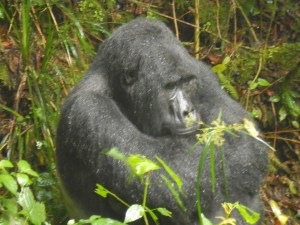
A moment later the silverback went to some shrubs to eat, sat on a branch and fell into a small ravine. He didn’t seem too bothered.
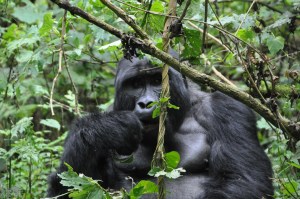
The rest of the gorillas followed him into the ravine. We were told to wait while the trackers located them again. The one-hour clock was still ticking. After 15-20 minutes we went up a very steep bank and spotted them again. The guide had to hack a path with his machete.
A little baby was rolling around and being a kid while its mom tolerated his antics. The male was sprawled out like a drunk who passed out on his bed. Two other females sat nearby.
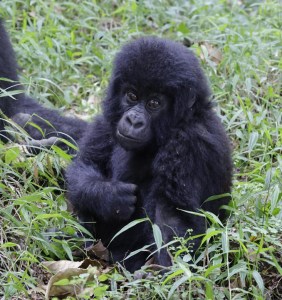
Then it started to rain. There is a reason they call it a rain-forest – it POURED. Gorillas don’t like the rain. They sat huddled, hugging themselves and looking very miserable. We tried to take more pictures, but it was raining so hard our cameras wouldn’t focus and our cell phones got wet. Too soon our hour was up and we had to head back.
The trail was bad enough when it was dry, now it was slippery wet. We had to climb that very steep hill we came down on. We were slipping and sliding, hanging on to branches and trying to gain a foothold on roots. Sara commented that if the person in front slips, we would all go down like a string of dominoes. It made me step off the trail slightly whenever we had to wait for the line to move.
Back at the Ranger office, they presented us with certificates for tracking gorillas. They made a big deal out of it. They called each of us up individually and presented our certificate, while the rest of us clapped and cheered like it was a graduation. It WAS a big deal!
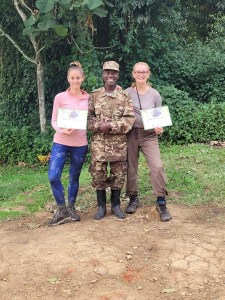
The highlight of the trip was over. We headed back to the lodge, euphoric and giddy from the experience. On the way back we met a motorcycle carrying a bright yellow loveseat on the back. We were in hysterics! It was the perfect end to a perfect day and a perfect holiday.
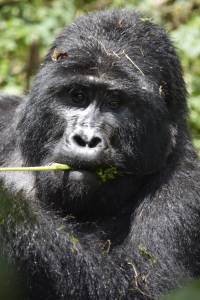
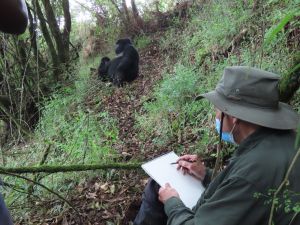
While everyone was frantically taking pictures of the gorillas, Fred was sketching them.
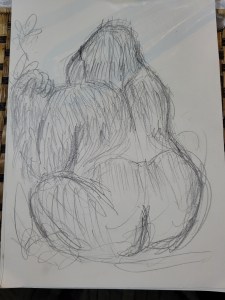
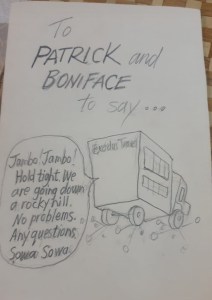
That night, our last night as a family, we presented Patrick and Boniface with a thank you card that Fred drew. Martin gave a lovely speech on behalf of us all. Eli read a poem she had written.
 An Old Lady with a Backpack
Leave a comment