
October 30, 2022
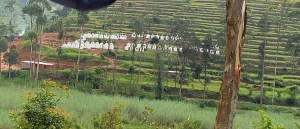
My boots were still soaked from the previous night’s washing. A hotel staff member offered to wash our muddy boots after our gorilla trek. She dunked them. I had to get plastic garbage bags from the hotel in order to wrap them up to put into my backpack. A small inconvenience.
We were headed to Rwanda. We needed gas. As we were pulling into the service station, a car was at the pump already. The attendant shooed him away as he saw us pulling in. “Get out of the way! This is a BIG customer!” LOL
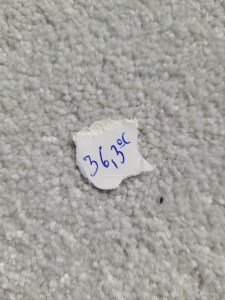
At the Rwandan border, we had to walk through a bleach bath with our shoes, wash our hands and get our temperature taken. We then had to present our tiny scrap of paper to an official-looking panel to get our exit stamp. Stand behind the line 2 meters back – not even a toe over, but its OK not to wear a mask. Lean forward as far as we could to show the scrap of paper to them and show them our passport (they didn’t want to touch it) Back in the truck, Patrick said he hoped we had hung onto our health check.
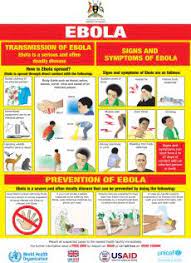
There were posters cautioning about Ebola. Patrick had a theory about Ebola. Even though he made a point of us skirting around Kampala, his view is there has been gold discovered near there. Ebola was created to scare people away. He said if Covid could spread worldwide in one month, why is Ebola only in that area?
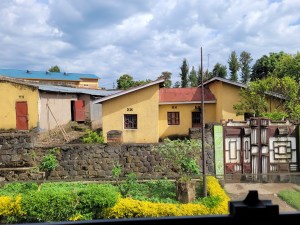
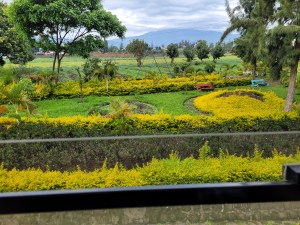
My first impressions of Rwanda are they seem a lot more affluent. The houses are much nicer. The yards are nicer and neater. (Rwanda was one of the first places to ban plastic bags) Even their shacks looked better.
I saw beautifully groomed parks in their modern cities. They don’t have crops growing in every available space of land.
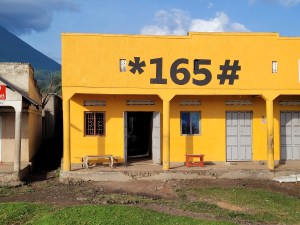
There were lots and lots of yellow buildings. I asked Patrick why. He said that businesses will paint your house or shop for free if it is in their company colour. Yellow was MTN mobile, red was Airtel, and orange was Mango.
There were no bumps at every village, so we could make good time. However, the roads were very winding and not conducive to a high speed.
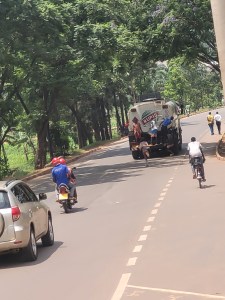
We saw a bunch of young boys running after and hitching a ride on the back of a petrol truck. Boys will be boys.
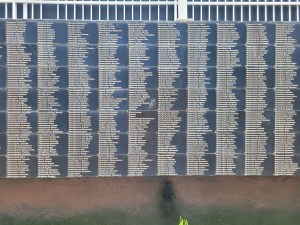
We only had an hour at the Genocide Memorial. It was not nearly enough time. This is what I learned during my short visit.

The native people were one tribe and one language when the colonists arrived in the late 19th century. The colonists noticed that some had more cows than others. Anyone owning over 10 cows was Tutsi (14% of the population), and anyone under 10 cows was Hutu (85%). They were issued ethnic identity cards. The Tutsi were favoured for higher positions within government, administration and education. Naturally, the Hutu didn’t like that. They were the majority, after all. Where was this democracy that the colonists talked about? They started demanding equal rights.
In 1962 Rwanda got its Independence from Belgium, which only exasperated the ethnic tension. Many Tutsi fled to neighbouring countries, like Uganda, where they had their own murdering dictators. The Tutsi dreamed of going home to Rwanda. Things were better in Burundi, the Tutsi were still in power – and murdering the resident Hutu. The Hutu ran to Rwanda, where their people were now in power, and swore to never let the Tutsi treat them badly again.
This was bad news for any Tutsi still in Rwanda. The Hutu were afraid that the Tutsi might come looking for revenge. The Hutu were very afraid and decided that if the Tutsi rose up they would wipe them off the map. In the meantime, foreign aid was pouring into the country, but winding up in corrupt Hutu corrupt minister’s pockets. The common people were still poor. Crashing coffee prices in the 1980s didn’t help matters.
In 1990, the Tutsi children of the Ugandan refugees decided it was time to go home and sort things out. They formed an army, the Rwandan Patriotic Front, and headed back home to create a war against the Hutu Rwandan Army. The Hutu government of Rwanda created a media campaign saying “The Tutsi are coming. They are snakes. They will murder your children. They will take away your land and turn you into slaves. (which IS how it was 150 years ago.) Despite foreign encouragement to enter talks, the government Hutu were not about to give up power and kept stirring the crazy pot, until the Hutu were nearly out of their minds with fear.
On 6 April 1994, the Rwandan president’s plane was shot down. Although it is one of the great murder mysteries of the 20th century as to who actually did it, the Hutu put out the message that it was the Tutsi. It was time to act! Kill them all!! During the next 100 days between 500 and 650 thousand Tutsi and moderate Hutu and Twa were killed by Hutu militias. Neighbour turned on neighbour. Where there was doubt as to which side you were on, the Ethnic ID cards came in handy. (Thank you, colonists) Nowhere was safe. People fled to schools and churches, where they were sitting ducks. It wasn’t good enough to simply kill them, they were tortured first. Hundreds of thousands of women were raped.
The UN was on the scene for 3 years before the killings began. Commander Romeo Dallaire became aware of the threat and requested to raid a secret cache of Hutu weapons. One of the poorest counties in the world was suddenly the 3rd largest importer of weapons. He was turned down. The Hutu government was controlled by the genocidaires. The Tutsi side said they needed to fight to stop the killings. (Is that the same as screw to protect virginity?) He later went on to call his time there a failure.
Outside, there were huge mass graves, where 250,000 victims’ bodies have been brought for burial. It was a beautiful, yet sombre garden setting.
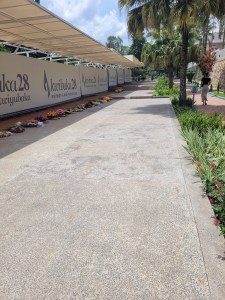
I would have liked to learn more, but it was time to leave. We had a shuttle to catch to take us to the airport and catch our plane back to London.
 An Old Lady with a Backpack
Leave a comment